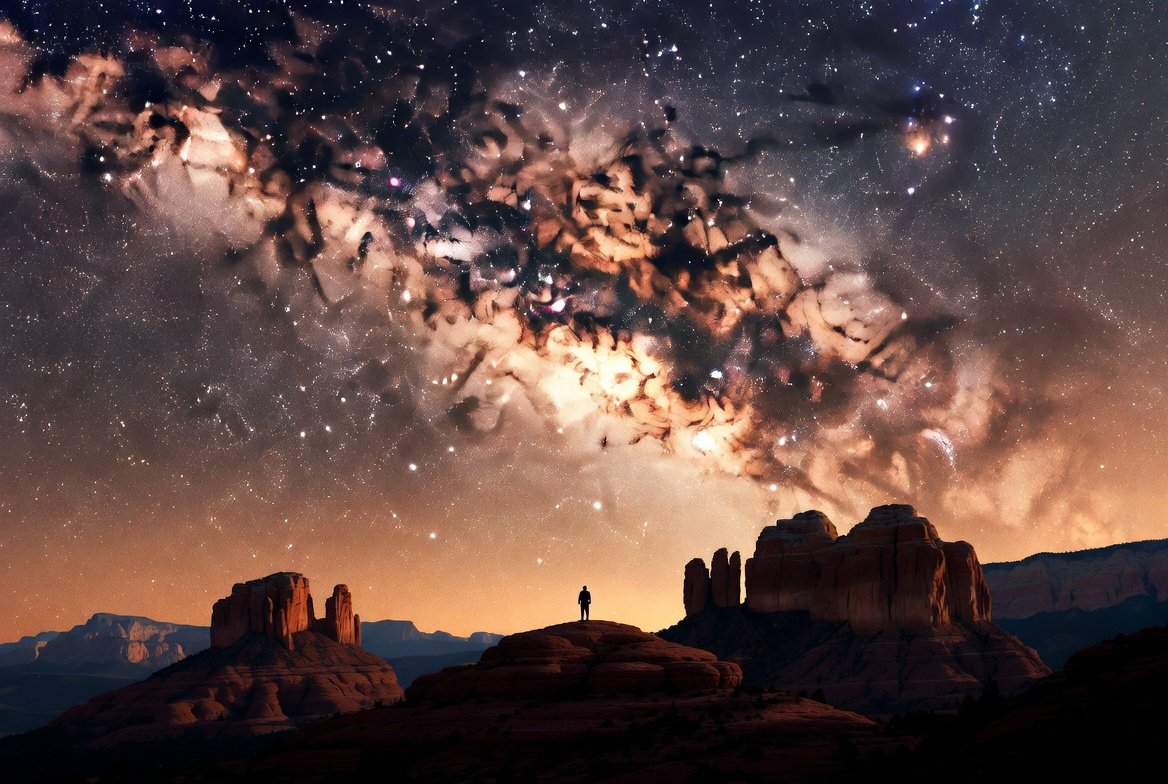
Sedona became an International Dark Sky Community in 2014 — one of about a dozen in the country. That designation isn’t just marketing. It means the city enforces lighting ordinances strong enough to preserve genuinely dark skies, which is rare in a town of this size.
Practically, it means that on a moonless night, away from the main streets, you can see the Milky Way with the naked eye. That sounds like a small thing until you actually experience it.
Here’s how to make the most of it.
When to go
New moon is everything. The Milky Way is visible any clear night, but the moon washes out fainter stars. Check a moon phase calendar and aim for the 5-day window around new moon.
Summer through early fall is best. The core of the Milky Way — the bright, cloudy band in Sagittarius — is highest in the sky from May through October. In winter, you still get great stars, but the galactic core is below the horizon.
Avoid monsoon evenings. Late July through early September brings thunderstorms that can roll in fast. Check the forecast day-of.
Where to go
You don’t have to drive far. Sedona’s dark-sky designation means even light pollution in town is minimal compared to most American cities.
For serious stargazing, try:
The Airport Overlook. Counter-intuitively, this is a great spot. Drive up the hill, park at the overlook, and look away from town (south-southeast). Minimal light, panoramic sky.
Schnebly Hill Road. About a mile up this unpaved road puts you in near-total darkness with mesas on either side. Don’t drive further unless you have a high-clearance vehicle. The road is no joke beyond the first mile.
Red Rock State Park (after-hours events only). The park hosts periodic star parties with astronomers and telescopes. Check their calendar.
Your Airbnb’s backyard. If you’re staying in a West Sedona neighborhood and you turn off the porch lights, you’re going to see more stars than you’ve seen in years. No drive required.
What to bring
A red flashlight (or put red cellophane over a regular one). White light kills your eyes’ dark adaptation for 20+ minutes.
Warm layers. Sedona gets cold at night even in summer — high desert temps can drop 40°F after sunset.
A star chart or app. Sky Guide and Stellarium are both excellent. Hold your phone up and they show you what you’re looking at.
Patience. Your eyes need at least 15 minutes in full darkness to adjust. Don’t check your phone every 30 seconds.
Optional: binoculars. A cheap pair of 7x50s will show you craters on the moon, the moons of Jupiter, and star clusters you can’t see with the naked eye.
What you’ll actually see
On a good night, away from any lights, with adjusted eyes:
The Milky Way as a distinct band across the sky.
Four of Jupiter’s moons, if Jupiter is up (binoculars required).
Satellites, shooting stars, and occasionally the ISS.
Constellations you thought were ancient mythology but suddenly make geometric sense.
A few honest notes
Stargazing is one of those experiences that’s wildly variable. On the right night — clear, moonless, away from lights, warm enough to be comfortable — it can be the most memorable thing about your trip. On the wrong night — monsoon haze, full moon, cold — it’s just sitting outside.
Check the forecast, check the moon phase, and give yourself a two-night window rather than banking on one.
And turn your phone to airplane mode. Notifications are the fastest way to ruin it.
Where to stay
All five of our featured properties are in West Sedona, which benefits fully from the dark-sky ordinance. The Enchanted Adobe Hideaway has an especially good outdoor space for stargazing — covered patio, kiva fireplace for the cold nights, and a yard oriented away from any streetlights. Sage House and Rose Quartz Playhouse both have substantial decks with mountain-facing sight lines.